Atopic dermatitis treatment in Madrid (Spain)
Dr Álvaro González Cantero
Specialist management of an inflammatory disease that can significantly affect quality of life
Atopic dermatitis is a chronic inflammatory skin disease that can be difficult to control, particularly in moderate and severe cases. Its impact on quality of life can extend well beyond the skin, affecting sleep, emotional wellbeing and everyday activities.
Although it is more common in childhood, atopic dermatitis can also affect adolescents and adults and may present in forms that are more difficult to treat and have a considerable impact on daily life. In these cases, a specialist and personalised approach is important in order to achieve better disease control.
Throughout my work as a dermatologist, I have seen many patients spend years trying different treatments without achieving adequate control of their condition. My aim is to provide a detailed assessment of more complex cases, combining accurate diagnosis with the most appropriate advanced treatment options currently available.
As a dermatologist specialising in atopic dermatitis and other inflammatory skin diseases, I provide an in-depth assessment based on current scientific evidence and a personalised approach that takes each patient’s individual needs into account. I see patients at Grupo Pedro Jaén, with in-person consultations in Madrid, online consultations and second opinion consultations.

Specialist assessment of complex atopic dermatitis and advanced treatment options
What is atopic dermatitis?
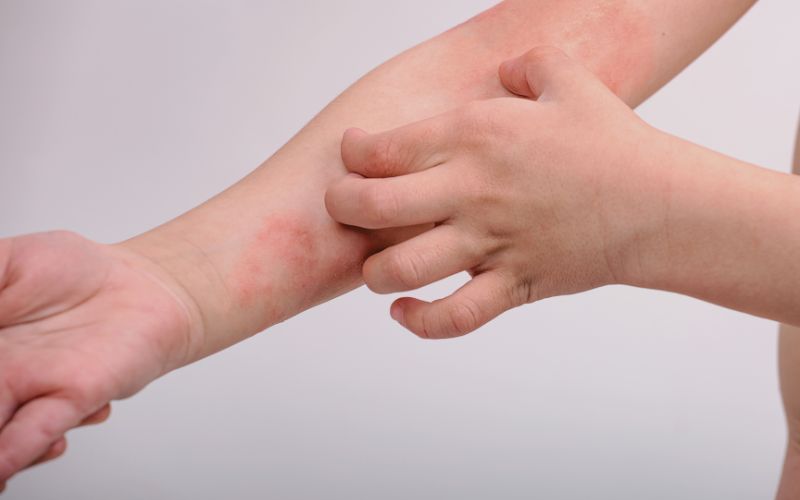
Atopic dermatitis is a chronic inflammatory skin disease characterised by recurrent flare-ups, typically involving dry skin, eczema and intense itching. One of its main features is impairment of the skin barrier. This causes the skin to lose water more easily, become more sensitive and be more vulnerable to irritants, allergens and other environmental triggers.
In addition to the changes affecting the skin barrier, atopic dermatitis has a complex immunological basis. In people with this condition, the immune system may overreact to stimuli that would not normally trigger inflammation. This contributes to a recurring cycle in which the skin becomes irritated and inflamed and is increasingly vulnerable to infection.
Together, these mechanisms help explain why atopic dermatitis can be particularly persistent in some patients and why it may be associated with other atopic conditions, such as asthma, allergic rhinitis or allergic conjunctivitis.
What causes atopic dermatitis?
Atopic dermatitis is a multifactorial condition involving several contributing factors:
- genetic predisposition;
- impairment of the skin barrier;
- abnormal immune responses;
- environmental factors and triggers;
- and changes in the skin microbiome.
A personal or family history of atopic dermatitis, asthma or allergic rhinitis is common. We also know that certain factors can worsen the condition or trigger flare-ups, including sudden changes in temperature, sweating, stress, certain fabrics, specific irritants and secondary skin infections.
Triggers vary considerably between patients, as does the way individuals respond to them. Identifying the factors that may be influencing each case is therefore an important part of treatment.
When atopic dermatitis becomes more than “just eczema”
One of the problems associated with atopic dermatitis is that its impact can sometimes be underestimated.
Some patients live for years with itching, disrupted sleep, frequent flare-ups, repeated courses of corticosteroids and persistent frustration, as though these were unavoidable consequences of the condition. Better disease control may often be possible.
Moderate or severe atopic dermatitis can have a substantial impact on sleep, everyday functioning, emotional wellbeing and social life. In some cases, it requires a considerably more precise strategy than repeatedly prescribing topical treatments.
When the condition is not adequately controlled, a more detailed assessment is therefore appropriate.
How does atopic dermatitis present?
Atopic dermatitis can present in different ways depending on the patient’s age, the location of the lesions and the severity of inflammation.
Common symptoms include:
- intense and persistent itching;
- eczema affecting different areas of the body;
- marked skin dryness;
- skin irritation and sensitivity;
- lesions caused by scratching;
- an increased tendency to develop skin infections;
- sleep disturbance;
- and an associated emotional impact.
In babies and young children, the cheeks, neck, arms and legs are commonly affected. In adolescents and adults, the condition frequently affects the neck, hands, eyelids and the folds of the elbows and knees, although its distribution can vary considerably between patients.
Diagnosis and individual assessment
Not all cases of atopic dermatitis are the same, and not every patient requires the same investigations or treatment.
During the consultation, I carry out a detailed assessment to understand:
- how the disease presents;
- the severity of flare-ups;
- how much it interferes with quality of life;
- which treatments have been used previously;
- whether there are potential triggers;
- and whether associated factors may be contributing to its progression or poor control.
In selected cases, additional investigations may be appropriate, including allergy testing, blood tests or, when required in atypical cases, a skin biopsy.
The objective is not simply to give the condition a name, but to understand how it behaves in each individual patient so that a more appropriate treatment strategy can be developed.
Dermatologist specialising in atopic dermatitis treatment in Madrid (Spain)
Atopic dermatitis treatment: more than managing a flare-up
Treatment of atopic dermatitis should be tailored to the patient’s age, disease severity, frequency of flare-ups, location of lesions, impact on quality of life and response to previous treatments.
Depending on the individual case, management may include:
- skin barrier care and appropriate moisturisation;
- topical anti-inflammatory treatment;
- patient education and flare-up prevention;
- management of triggers;
- treatment of infections or other complications;
- systemic therapies;
- and, when indicated, advanced targeted therapies aimed at controlling inflammation more precisely.
My aim is not simply to relieve an individual flare-up, but to develop a strategy that helps reduce recurrences, improve disease control and restore greater stability to the skin.
Complex cases and advanced treatment options
One of the most important developments in atopic dermatitis in recent years has been the introduction of new targeted therapies for moderate and severe disease.
These options have expanded the therapeutic possibilities for patients who previously experienced inadequate control, required repeated or less suitable long-term treatments, or whose quality of life remained significantly affected.
In complex cases, the key is not simply having these therapies available. It is also important to determine when they should be considered, select the most appropriate strategy, monitor treatment correctly and integrate these decisions into the patient’s overall management plan.
A comprehensive and personalised approach
Atopic dermatitis should not be managed solely by focusing on visible skin lesions.
Appropriate management also requires consideration of:
- the patient’s individual circumstances;
- the true impact on sleep and quality of life;
- the role of potential triggers;
- the presence of other atopic diseases;
- the associated emotional impact;
- and how the disease changes over time.
My approach is therefore based on personalised care, supported by current scientific evidence and aimed at identifying the most appropriate strategy for each patient rather than repeatedly applying the same standard treatments.

Dr Álvaro González Cantero
Medical registration number: 454505859
Dermatologist specialising in atopic dermatitis treatment in Madrid (Spain)

Access to therapeutic innovation and investigational options
For most patients, the priority is to achieve the best possible disease control using currently available treatments that are appropriately indicated for their individual case.
However, for selected patients with complex atopic dermatitis or an inadequate response to conventional treatments, it may also be appropriate to consider investigational options within a medically, ethically and scientifically supervised setting.
This forms part of the clinical and research activity I carry out at Hospital Universitario Ramón y Cajal and ICMR (International Center for Medical Research), the dermatology research centre of Fundación Pedro Jaén, where I am Director General This work allows me to remain closely connected with emerging therapeutic strategies and, for selected patients, to assess potential participation in ongoing research into atopic dermatitis and other inflammatory skin diseases.
These options do not replace approved treatments and are not appropriate for every patient. However, they may provide an additional possibility in selected cases, particularly when the disease continues to have a significant impact despite appropriate management.
When can specialist assessment be particularly helpful?
A specialist assessment of atopic dermatitis may be particularly useful when:
- flare-ups are frequent or severe;
- itching interferes with sleep or everyday life;
- the current treatment is not providing adequate control;
- repeated courses of corticosteroids are required;
- there is uncertainty about the diagnosis;
- the disease is having a significant impact on emotional wellbeing;
- it may be appropriate to consider a more advanced treatment;
- or a second opinion is required for a complex case.
In-person consultations in Madrid, second opinions and online consultations
Consultations are available in person in Madrid at Grupo Pedro Jaén, or online when the nature of the case allows an appropriate remote assessment.
A second opinion consultation may also be particularly useful for patients with difficult-to-control atopic dermatitis, diagnostic uncertainty or a need to review important treatment decisions.
In every case, the aim is the same: to provide a rigorous and personalised assessment focused on achieving better disease control.
Dr Álvaro González Cantero
Consultations at Grupo Pedro Jaén


If you are looking for an atopic dermatitis specialist
If your atopic dermatitis is not adequately controlled, itching or flare-ups are having a greater impact on your everyday life than they should, or you would like a more detailed review of your treatment, I can assess which strategy may be most appropriate for your individual case.
The aim is not simply to treat the skin, but to understand the disease properly and develop an approach that helps improve both disease control and quality of life.
Related information
If you would like a more detailed diagnostic and therapeutic assessment, you can visit the Dermatology Second Opinion Consultation section.
If you would like information about remote assessment, you can visit the Online Consultation section.